
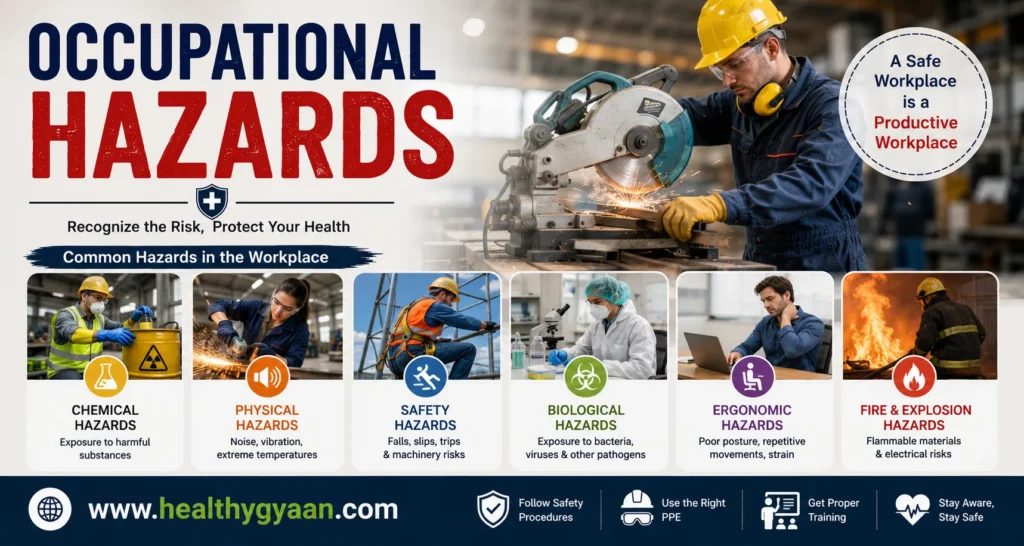
The Overall Aspects to understand the health impacts and solutions of Occupational Hazards in our life
All the people in the entire world are engaged in some different kinds of occupation that actually varies with the place,time and the manner of the jobs.These all the sectors are not always free from occupational hazards as they most of the time encompasses all the dangers where the employees may face in the workplace.The overall health impacts can sometimes go beyond the physical and mental health as well as these risks can also impact a company’s performance.
That is the reason why risk management must be in our top priority for the employers in their respective workplaces.Therefore,it not only ensures the protection to the teams but also improves their quality as well as the performance of their work life and guarantees compliance with legal obligations.
In this informative article,we try to explore the overall main types of occupational hazards along with its risk assessment and also learn how to identify them in a professional way.
Some of the Main Types of Occupational Health Hazards
Though occupational health hazards may be distinct types in accordance with the time,place and manner of the occupation,they are mostly categorised into some primary and secondary occupational health hazards.Here we try to provide you some of the important lists of primary occupational health hazards.These comprises:
Physical occupational health hazards
These occupational health hazards mainly include workplace accidents, for example falls, burns, and injuries due to machinery causes that involve crushing or trapping.Physical hazards are especially very much common scenarios on the construction sites and it mostly occurs in the industrial sector.When you plan to raise awareness to perfectly manage these physical occupational hazards,you can definitely consider about organizing a safety day.
Chemical occupational health hazards
These types of occupational health hazards mostly happen due to exposure to some hazardous substances involving solvents or most of the cleaning products.
Ergonomic and psychosocial risks hazards
Musculoskeletal disorders within the human body are among the cases that are the most frequent ergonomic issues arising from the occupational sites.These disorders are actually the ultimate result due prolonged poor posture or inappropriate design of the workstations where the employee usually work.If you want to mitigate them professionally,you must need to implement occupational risk prevention training strictly within your company.
There are also some psychological risks erupted from the occupational sites though they are invisible most of the time in nature unlike the other occupational hazards.These psychological health risks generally involve stress, harassment along with violence, and burnout.
Important legal Obligations in relation to Occupational Health Hazards
There are some important legal obligations that possess a close relation to the occupational health hazards.These common most important obligations are:
Workplace Safety Legislation accepted worldwide
The article no. L421-1 of the French Labor Code strictly indicates that employers must be required to take the necessary and initial steps to ensure their safety and protection of the physical and mental health of their employees.
This workplace role actually contains some crucial responsibilities that actually possess a close relation with the preventive measures in the working environment.It further acts as a single document for the evolution of occupational risks namely DUERP.This also provide a concrete standards like ISO 45001 and it definitely help manage the workplace risks in more efficiently.
Mandatory specialised Employee Training on Specific Hazards
It remains as a vital matter that the employers must ensure they make their teams sufficiently skilled to handle any kind of occupational hazards.The proper delivery of the information towards the employees about the accidents actually help prevent them from happening further and that eventually help keep everyone healthy.It is not only for the protection of the team but also proper skill ultimately builds a strong culture throughout the entire company.Thus,it ultimately result in saving a significant amount of money in the long term.
Experts used to divide training programs into two distinct categories that comprise firstly general workplace safety training and secondly industry-specific safety training.The latter is generally on the basis on the list of identified and recognised occupational hazards.
Importance of sharing Employer and Employee Responsibilities
Workplace safety mainly depends on the actions of both the employers and their teams.Employers always possess the role to ensure the proper safety and necessary safeguards in place as it can secure everyone’s protection.On the other hand,the employees must also strictly follow the safety guidelines provided by the employers.Therefore,they need to ensure that they wear the safety tools and constantly follow the the emergency procedures.After all,when both sides do their respective roles perfectly,it will then ensure a safe workplace.
Discover more here: Boursin stuffed dates and Watermelon carpaccio
The Consequences of Uncontrolled Workplace Risks
If the workplace risks or occupational hazards can not be minimised to a certain degree,it can definitely bring about some disastrous situations to the employees who used to work in the workplaces.The consequences of uncontrolled workplace risks comprise:
Overall negative and harmful Impact on Employee Health
Poor risk management eventually results in more workplace accidents along with injuries, and chronic illnesses.These incidents possess a negative and harmful impact on the health of victims in an industrial area and thereby cause pain,and sometimes end up with temporary or permanent disability. In some severe cases, they may even lead to ultimate fatalities which can have a significant psychological and severe mental impact on coworkers who usually witness such events with their own eyes.
Financial Costs of the aggrieved party
The poor risk management can bring about the negative financial consequences which significantly causes some damages to its employee.It is very vital to compensate the employees due to injuries in working environment and also ensure full medical expenses.Moreover,the organisation can also suffer a lot as they are forced to have the productivity losses in case of absenteeism,production downtime, and concurrent demotivation.
Furthermore, it could also face fines for non-compliance together with some legal requirements.To avoid financial disruption,it is very crucial for the authority to identify workplace hazards and thereby implement suitable prevention measures in accordance with the situation.
Negative Impact on Company’s overall Reputation
When there is a serious and life-threatening workplace accident or occupational hazards like an explosion, or a scandal involving harassment or severe degree of violence,it can then severely damage a company’s outlook. It may be perceived or realised as an organization that generally neglects their employee safety and overall well-being.
This loss of trust from their clients and partners or shareholders can have a long-lasting effect.It takes a lot to recover from a situation like this and this is because many companies find it hard to recruit new talent afterward, and some are eventually forced to shut down.
What is the understanding of an Immersive Factory?
An Immersive Factory is that kind of factory which usually offers a wide range of virtual reality training modules and facilities.Experts in industrial evolution currently believe that a purely theoretical and proactive approach is no longer enough to transmit the knowledge in a successful way among the employees.
That’s why their training sessions need to be designed to be very interactive and participatory. This method can definitely help the employers ensure better knowledge retention as well as long-term behavior change among the employees.Safe simulations not only let employees experience risks firsthand but also make them sharper at spotting hazards and more likely to stick to the rules.
Impacts of an Immersive Training in a factory
To enhance risk understanding towards the employee,this training program genuinely integrates risk simulation in a digital and modern environment. Participants can certainly experience different scenarios facing occupational hazards such as fires, falls, or handling the hazardous substances that they may need to encounter in the factory.
It forces them to make split-second choices and immediately see the fallout.These practice runs build strong instincts as well as help keep them alert and prepared when it really counts.
How to execute a Safety Day
The appropriate training of the teams in a company should be achieved in an effective way through safety days that include interactive workshops together with hazard hunts, and remote training through a virtual campus.
There are also some necessary programs that are designed to be fun, engaging, and interactive and thus they help make them more impactful. In addition to these programs,they can be significantly tailored to the company’s needs and as per the demands of the industry sector.
Workplace risk factors in the occupational environment
Workplace risks are the usual issues that indicate the chance of occupational hazards occurring in the workplaces.These are the factors especially influencing the risks of hazards.These comprise:
1.Frequency
It actually means the number of times a worker is getting exposed to causes that ultimately lead them to illness or injury.It can only be determined when the accidents occur. Chronic exposure to these hazardous causes that occurs mostly in a frequent and regular manner,like daily or weekly generally increases the risks of disease and injury in comparison to exposure that happens seldom, like once a year.
2.Exposure type
These risks in fact mean the exposure to occupational hazards to the workers inside the company through ingestion, skin contact, or inhalation.Therefore,there are also more severe types of hazards like gases that can quickly spread in the air and can affect more people within a short span of time.
3.Extent of exposure
The extent and duration of exposure of occupational hazards can vary in many ways as they may be low, medium, or high in terms of severity.Chemical concentrations together with its long duration of exposure will unfortunately increase the risk of illness development and compromise the worker safety as well.
In a nutshell,Occupational risks aren’t always immediate as many of them take years to surface.And when chemical or biological threats escape the workplace, they become the overall public health concerns. That’s why occupational safety and public health go hand-in-hand that can ensure worker safety as well as directly protect the surrounding community.
Conclusion
After all, we should always be cautious in engaging in any kind of work and we also need to follow the legal requirements in relation to our workplaces.It remains as an obvious factor that no corporate sector is fully immune in terms of dealing with physical risks on the specific job sites.It is in fact demands us to properly manage the workplace hazards than a legal requirement.Honestly,traditional safety lectures can rarely change our everyday behaviour and thus effective safety mostly relies on a shared responsibility between the employees and employers.
The organizations can actually get the victory in managing all possible occupational hazards when they become proactive in the identification of risks and invest more in advanced training.Therefore,they can be able to build a healthier workplace culture and it will surely then benefit our society.